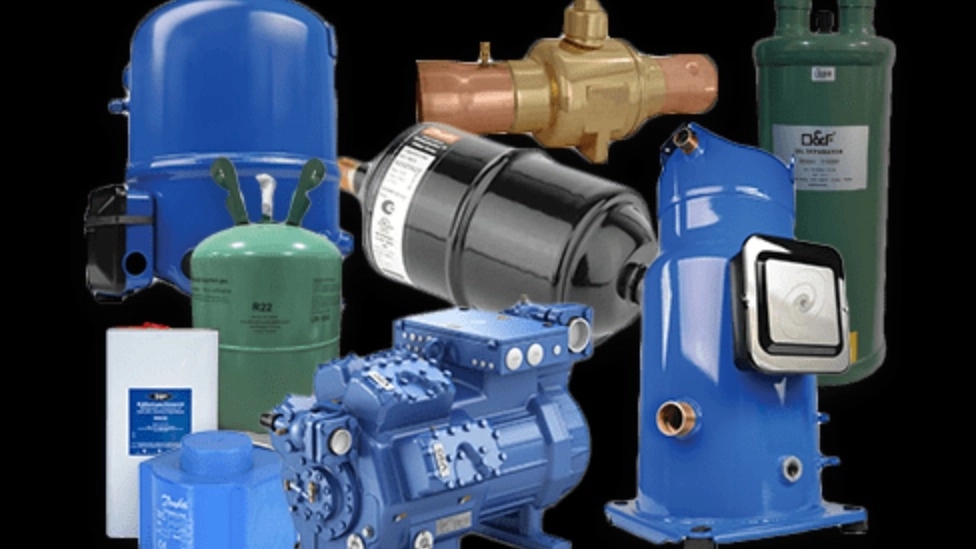
What is a Refrigerator Compressor?
The compressor plays the role of the heart of the compression cooling system.
The role of the compressor starts from the suction of the gas passing through the evaporator, which carries the heat absorbed from the room, and ends by condensing it from low temperature and pressure to high temperature and pressure and pushing the refrigerant in order to remove its heat.
Compressor History and Cooling Systems
If we consider a compressor as a device that compresses gas, with this interpretation, humans have been using compressors for their work since 5 thousand years before Christ. In fact, when they started melting metals, they used blowers to compress the gas and blow it towards the flame.
But in 1758, Benjamin Franklin was able to reduce the temperature of an object by using a blower and alcohol. He blew compressed air over the alcohol using a blower. By doing this, he was able to reduce the temperature to freezing. In fact, by doing this, mechanical cooling systems were established.
After that, ammonia was the first refrigerant used for the temperature reduction process. In the middle of the 19th century, something similar to today's refrigeration cycles was developed, where a low-pressure liquid turned into a gas by receiving heat. Then this gas was compressed with a compressor and after that in a condenser, its temperature was reduced and it turned into a liquid again. During the following years, the technology of making compressors improved and more complex and more efficient compressors were made than piston compressors.
How Compressor Works
To better understand what a compressor does, you need to know about refrigeration cycles. When the compressor starts working, it takes the low pressure refrigerant from the operator. The refrigerant that is sucked from the operator actually carries the heat absorbed from the refrigerator, and this energy must be somehow transferred to the outside environment. But heat exchange happens when the gas temperature is higher than the ambient temperature. By reducing the gas volume, the compressor increases the gas pressure, and as a result, the gas temperature also increases. After increasing the temperature of the refrigerant, the compressor acts as a pump and sends this hot gas to the condenser so that its temperature decreases.
Compressor Types
There are different types of compressors that may confuse people at first. Therefore, various categories are provided for grouping compressors that can be used in the right selection. In general, compressors are classified with the following features: • Speed (fixed speed or variable speed) • Number of work steps (single-step, two-step and multi-step) • Power system Structure (open, toxic, hermetic and hermetic) Compressor cooling system (air, water and oil) • Compressor lubrication methods However, the above items are not enough to fully categorize compressors. Typically, the most useful classification for compressors comes down to how they work. To increase the pressure of a fluid, two methods can be used: reducing the volume or increasing the speed. The compressors that use the first method are called positive displacement compressors and the compressors that increase the fluid speed are called dynamic compressors.
Differences of Chiller Compressor, Cold and Cooling Systems
The types of compressors mentioned above can be used in chillers and cold stores depending on the application. In chillers, scroll compressors are usually used to cool water in small dimensions (capacity less than 200 tons). The capacity of these compressors usually starts from 20 tons. To increase the capacity of systems that use scroll compressors, the number of compressors should be increased. The weakness of this issue is that the capacity of the chiller can only be increased step by step and it is not necessarily possible to reach the desired capacity. But the advantage of this method is that if one of the compressors breaks down, although the capacity of the system decreases, the system does not shut down completely.
Normally, a maximum of 6 scroll compressors of 30 tons are used together, and for larger capacities, screw compressors should be used. Such compressors can have a capacity of up to 500 tons. For these compressors, it is possible to adjust their working capacity between 20% and 100%, and therefore, the desired capacity can be obtained precisely. Screw compressors have a high efficiency compared to other common compressors, but the sound they produce is more than scroll compressors.
Compressor Oil
Compressor oil performs several different roles at the same time, and of course, its most important task is the lubrication of parts. But at the same time, in some systems, oil is also used as a coolant. Also, as mentioned before, in open compressors, oil plays the role of preventing leakage. With this in mind, one should be very careful in choosing the oil for the compressor and the manufacturer's suggestions should be taken into account.
Compressor oils are usually made up of a special blend of conventional oils and a few additives that are compatible with the refrigerant while lubricating the parts. If the oil and refrigerant have the slightest incompatibility, it may cause a lot of damage to the various parts of the refrigeration system.